
Imagine spending months optimizing your website for Google, reaching the first page of search results, and then discovering that users are no longer clicking those results because an AI assistant has already answered their question.
This is not a future prediction—it is happening right now.
Search behavior is undergoing one of the biggest transformations in internet history. Traditional search engines are increasingly integrating artificial intelligence into their platforms. Instead of showing users a list of websites, AI systems are generating direct answers by analyzing information from multiple sources across the web.
Platforms such as ChatGPT, Google AI Overviews, Gemini, Claude, and Perplexity are changing how people find information online. As a result, marketers, bloggers, businesses, and affiliate website owners must adapt to a new reality.
This is where Generative Engine Optimization (GEO) comes in.
Generative Engine Optimization is the process of creating and optimizing content so that AI systems can understand, trust, and reference it when generating responses to user queries. While traditional SEO focuses on ranking web pages, GEO focuses on making your content visible inside AI-generated answers.
For content creators and businesses, this represents both a challenge and an incredible opportunity. Those who adapt early can gain a significant competitive advantage in the evolving search landscape.
You’ll learn what Generative Engine Optimization is, how it works, why it matters, and how to build a GEO strategy that keeps your content visible in the age of AI search.
Quick Summary: Key Takeaways
- Generative Engine Optimization (GEO) helps content appear in AI-generated answers.
- GEO works alongside SEO rather than replacing it.
- AI systems prioritize expertise, authority, trust, and clarity.
- Well-structured content is easier for AI to understand and reference.
- Original insights and real-world experience increase citation opportunities.
- Strong brand authority improves AI visibility.
- GEO is becoming essential for long-term online growth.
What Is Generative Engine Optimization?
Generative Engine Optimization is the practice of optimizing content for AI-powered search engines and generative AI systems.
Traditional search engines display a list of links when someone searches for information. Users then click on those links to find answers.
AI-powered search works differently.
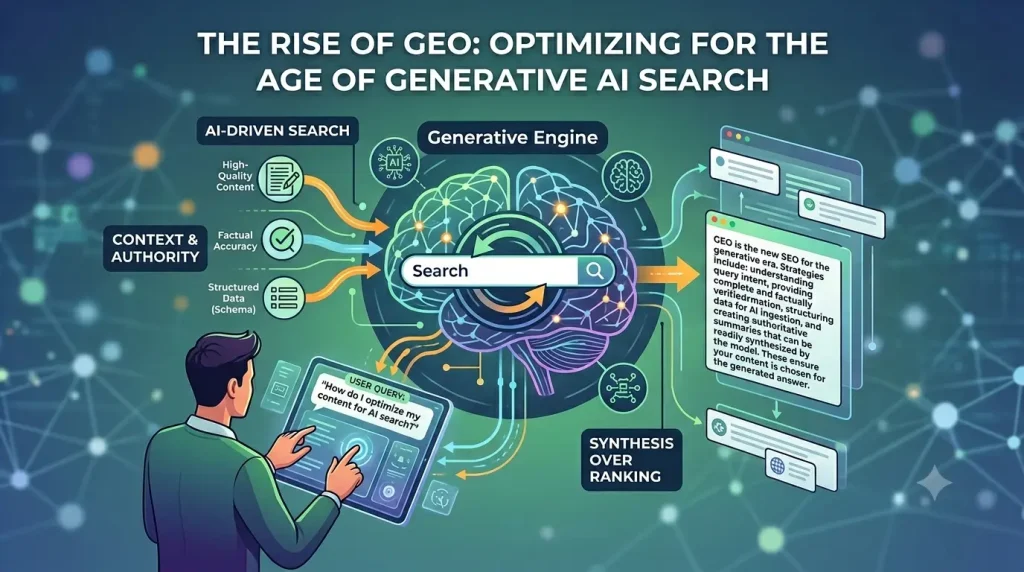
Instead of presenting a list of websites, AI systems analyze content from multiple sources and generate a direct response to the user’s question.
For example, a user might search:
“How can small businesses improve digital marketing results?”
Instead of displaying ten blue links, an AI assistant may provide a complete answer containing recommendations, explanations, and examples.
The websites referenced by the AI gain exposure, authority, and potential traffic.
Generative Engine Optimization focuses on increasing the likelihood that your content will be selected and cited by these AI systems.
In simple terms:
SEO helps users find your content.
GEO helps AI systems find, understand, and recommend your content.
Why Generative Engine Optimization Matters
The rise of AI-powered search is changing how information is consumed.
Users increasingly prefer conversational interactions because they are:
- Faster
- More convenient
- More personalized
- Easier to understand
Instead of opening multiple tabs and reading several articles, users can ask a single question and receive a complete answer instantly.
This shift creates new challenges for website owners.
The Challenge
Businesses that ignore GEO may experience:
- Reduced search visibility
- Fewer organic clicks
- Lower brand exposure
- Increased competition
The Opportunity
Businesses that adopt GEO early can benefit from:
- Increased AI citations
- Stronger authority signals
- Better brand recognition
- Higher trust among users
- Long-term competitive advantage
As AI search continues to grow, GEO will become an increasingly important part of every digital marketing strategy.
GEO vs SEO: Understanding the Difference
Many marketers assume GEO is simply another name for SEO.
In reality, they serve different purposes.
| SEO | GEO |
|---|---|
| Focuses on rankings | Focuses on AI citations |
| Targets search engines | Targets AI understanding |
| Optimizes keywords | Optimizes context and meaning |
| Drives clicks | Drives references and mentions |
| Improves SERP visibility | Improves AI visibility |
The best approach is not choosing one over the other.
Instead, successful websites combine both SEO and GEO to maximize visibility across traditional and AI-powered search experiences.
How AI Search Engines Evaluate Content
To succeed with Generative Engine Optimization, it’s important to understand what AI systems value.
Expertise
AI systems prefer content written by knowledgeable individuals.
Demonstrate expertise through:
- Industry knowledge
- Practical examples
- Detailed explanations
- Original insights
Experience
Real-world experience adds credibility.
For example, sharing actual campaign results or case studies provides more value than repeating generic advice.
Authority
Authority signals help AI determine whether a source is trustworthy.
Examples include:
- Quality backlinks
- Industry recognition
- Brand mentions
- Expert contributions
Trustworthiness
Trust remains one of the most important ranking factors.
Build trust through:
- Accurate information
- Reliable sources
- Updated content
- Transparent authorship
These factors align closely with Google’s E-E-A-T framework:
Experience, Expertise, Authoritativeness, and Trustworthiness.
The Five Pillars of Generative Engine Optimization
1. Create Comprehensive Content
AI systems prefer content that answers questions thoroughly.
A strong article should:
- Define the topic clearly
- Address common questions
- Include examples
- Provide actionable advice
- Cover related topics
Comprehensive content increases the chances of being cited by AI systems.
2. Focus on User Intent
Understanding user intent is critical.
Ask yourself:
- Why is the user searching?
- What problem are they trying to solve?
- What outcome are they looking for?
Content that satisfies user intent performs better in both SEO and GEO.
3. Structure Content Clearly
Well-structured content is easier for AI systems to process.
Use:
- Clear headings
- Short paragraphs
- Bullet points
- Tables
- Numbered lists
Good structure improves readability for both humans and AI.
4. Include Original Insights
AI-generated content is becoming common.
Original insights help your content stand out.
Examples include:
- Case studies
- Surveys
- Interviews
- Personal experiences
- Unique frameworks
5. Build Brand Authority
AI systems often prefer trusted brands.
Build authority through:
- Consistent publishing
- Guest posting
- Industry networking
- Public speaking
- Quality backlinks
Authority compounds over time.
How Businesses Can Prepare for the GEO Era
Many businesses are still focused entirely on traditional SEO, but the rise of AI-powered search means companies need to start preparing for GEO today.
The first step is to evaluate existing content. Businesses should identify their most valuable articles and determine whether they answer user questions comprehensively. Thin content that lacks depth may struggle to gain visibility in AI-generated responses.
The second step is to invest in expertise-driven content. Articles written from real-world experience tend to perform better because they provide practical insights that generic content often lacks.
Businesses should also focus on creating content clusters. Instead of publishing isolated articles, build multiple pieces of content around related topics. For example, a digital marketing website can create content about SEO, content marketing, email marketing, social media marketing, AI tools, and GEO. This strengthens topical authority and helps AI systems understand the site’s expertise.
Finally, companies should regularly review and update content. AI systems tend to favor accurate and current information, making content maintenance more important than ever.
10 Proven Strategies for Generative Engine Optimization
If you want your content to appear in AI-generated answers, these proven strategies can help.
1. Answer Questions Directly
Provide clear and concise answers near the beginning of your content.
2. Use Clear Heading Structures
Organize content with H1, H2, and H3 headings.
3. Publish Comprehensive Guides
Long-form content often provides the depth AI systems prefer.
4. Demonstrate First-Hand Experience
Share practical examples and case studies whenever possible.
5. Build Topic Clusters
Create multiple articles around the same niche.
6. Include FAQs
Frequently asked questions help AI understand user intent.
7. Use Semantic Keywords
Include related terms naturally throughout the content.
8. Strengthen Internal Linking
Guide readers and search engines through your content ecosystem.
9. Earn Quality Backlinks
Authority remains important for both SEO and GEO.
10. Update Content Frequently
Fresh information improves credibility and relevance.
Implementing these strategies consistently can significantly improve your chances of being referenced by AI search systems.
Common Myths About Generative Engine Optimization
As GEO becomes more popular, several misconceptions have emerged.
Myth 1: GEO Will Replace SEO
This is one of the most common myths. GEO complements SEO rather than replacing it. Businesses still need strong SEO foundations while adapting to AI search.
Myth 2: Only Large Brands Can Succeed
Many niche websites and independent bloggers are already appearing in AI-generated responses because they provide highly relevant and specialized information.
Myth 3: Keywords No Longer Matter
Keywords remain important. However, AI systems also focus heavily on context, intent, and content quality.
Myth 4: AI Content Automatically Performs Better
Content created solely by AI without human expertise often lacks originality and credibility. Human insights remain valuable.
Understanding these myths helps marketers focus on strategies that actually work.
Real-World Examples of GEO in Action
Many successful brands are already benefiting from GEO principles.
SaaS Companies
Software companies create detailed educational content that answers specific user questions. AI systems frequently reference these resources because they are comprehensive and authoritative.
Marketing Blogs
Leading marketing websites publish original research and industry reports. This unique information makes them valuable sources for AI-generated responses.
Niche Bloggers
Even small websites can succeed by creating specialized content that addresses highly specific topics.
The key is not size—it is usefulness and credibility.
GEO for Bloggers and Affiliate Marketers
Affiliate marketers have a major opportunity with GEO.
Instead of focusing solely on search rankings, they can optimize content to become trusted sources for AI-generated recommendations.
Effective content types include:
Product Reviews
Provide honest, detailed evaluations based on real experience.
Comparison Articles
Compare products objectively and explain key differences.
Buying Guides
Help readers make informed purchasing decisions.
FAQ Pages
Answer common questions directly and clearly.
How-To Tutorials
Step-by-step tutorials are particularly valuable because AI systems often reference instructional content.
Step-by-Step GEO Strategy
Step 1: Research Audience Questions
Find out what people are asking.
Use:
- Google suggestions
- Reddit discussions
- Forums
- Social media comments
Step 2: Create High-Quality Content
Focus on depth, clarity, and usefulness.
Avoid thin content that provides little value.
Step 3: Optimize for Semantic Search
Use related concepts naturally.
For example, alongside “Generative Engine Optimization,” include terms such as:
- AI search visibility
- AI-generated answers
- AI optimization
- Conversational search
Step 4: Build Topic Clusters
Create multiple articles around related subjects.
This strengthens topical authority.
Step 5: Update Content Regularly
Fresh content remains relevant and trustworthy.
Review articles regularly and update outdated information.
GEO vs SEO vs AEO
Another important concept is AEO (Answer Engine Optimization).
| SEO | GEO | AEO |
| Search rankings | AI citations | Direct answers |
| Keyword focus | Context focus | Question focus |
| Search engines | Generative AI | Answer engines |
| Clicks | References | Featured answers |
Modern content strategies often combine all three approaches.
Why GEO Matters for the Future of Digital Marketing
The digital marketing landscape has evolved many times over the past two decades.
We have seen the rise of search engines, mobile devices, social media platforms, voice search, and video content. Each shift created new opportunities for businesses that adapted early.
Generative Engine Optimization represents the next major evolution.
As AI becomes more integrated into everyday search experiences, users will increasingly rely on generated answers rather than traditional search results. This means visibility inside AI responses may become just as valuable as ranking on the first page of Google.
Businesses that start building authority, trust, and expertise today will have a significant advantage in the years ahead.
Rather than viewing GEO as a threat, marketers should see it as an opportunity to create better content, build stronger brands, and deliver greater value to users.
The future of search belongs to websites that consistently provide accurate, helpful, and trustworthy information. GEO is simply the framework that helps those websites become visible in an AI-first world.
Common GEO Mistakes to Avoid
Publishing Generic Content
Generic content offers little value.
Create content that includes unique insights and expertise.
Ignoring E-E-A-T
Trust and credibility matter more than ever.
Keyword Stuffing
Write naturally.
Overusing keywords can harm readability.
Poor Formatting
Long blocks of text make content difficult to process.
Use headings and lists.
Neglecting Updates
Outdated information reduces trustworthiness.
Best Tools for Generative Engine Optimization
Research Tools
- Ahrefs
- SEMrush
- Google Search Console
AI Research Tools
- ChatGPT
- Claude
- Perplexity
Optimization Tools
- Surfer SEO
- Frase
- Clearscope
Analytics Tools
- Google Analytics
- Microsoft Clarity
These tools can help improve both SEO and GEO performance.
Measuring GEO Success
Unlike traditional SEO, GEO requires new success metrics.
Monitor:
- Brand mentions in AI responses
- Referral traffic
- User engagement
- Content authority growth
- Search Console performance
Tracking these metrics helps measure the effectiveness of your GEO strategy.
The Future of Generative Engine Optimization
The future of search is becoming increasingly AI-driven.
Key trends include:
Personalized AI Responses
Users will receive customized answers based on preferences and behavior.
More Conversational Search
Natural language interactions will continue growing.
Greater Demand for Expertise
Original research and expert insights will become even more valuable.
Multi-Modal Search
Text, images, video, and voice will work together.
Businesses that adapt today will be better positioned for tomorrow.
GEO Checklist for 2026
Before publishing content, ask yourself:
✅ Does it answer user questions clearly?
✅ Is it structured properly?
✅ Does it demonstrate expertise?
✅ Does it contain original insights?
✅ Is the information accurate?
✅ Have you included FAQs?
✅ Is the content updated?
✅ Are internal links included?
✅ Is the content easy to read?
✅ Does it provide genuine value?
If you can answer yes to all these questions, your content is moving in the right direction.
Frequently Asked Questions
What is Generative Engine Optimization?
Generative Engine Optimization is the practice of optimizing content so AI systems can understand, trust, and reference it in generated responses.
Is GEO replacing SEO?
No. GEO complements SEO. Both work together to improve online visibility.
Why is GEO important?
As AI-powered search grows, GEO helps maintain visibility and authority.
Can small websites benefit from GEO?
Yes. Small websites can succeed by publishing expert, high-quality content.
What is the difference between GEO and SEO?
SEO focuses on rankings, while GEO focuses on AI-generated references and citations.
Which AI platforms matter most?
ChatGPT, Google AI Overviews, Gemini, Claude, and Perplexity are among the most influential platforms.
Final Thoughts on Generative Engine Optimization
One of the biggest advantages of Generative Engine Optimization is that it encourages businesses to create genuinely helpful content rather than focusing solely on search rankings. As AI-powered search continues to evolve, websites that prioritize expertise, accuracy, and user value will have a greater chance of being referenced in AI-generated answers. GEO is not just about adapting to a new technology; it is about building a stronger, more trustworthy online presence that benefits both users and search platforms.

Generative Engine Optimization is not just another marketing trend. It represents a fundamental shift in how information is discovered, consumed, and trusted online.
As AI-powered search experiences become more common, businesses that focus on expertise, authority, trust, and user value will have the greatest opportunity to succeed.
The goal is no longer simply ranking on the first page of Google.
The goal is becoming a trusted source that AI systems choose to reference when answering questions.
By implementing the strategies discussed in this guide, you can strengthen your visibility, improve your authority, and position your brand for long-term success in the evolving world of AI-powered search.
What do you think about Generative Engine Optimization? Share your thoughts in the comments and let us know how AI search is changing your content strategy.




Leave a Reply